
Consistent part identification
Dealers use the same current diagrams and part relationships instead of local document copies.
CatalogDistributors and dealer networks
Give dealers access to current diagrams and part data while adapting visibility, pricing context, language and commercial handoff to the channel they serve.
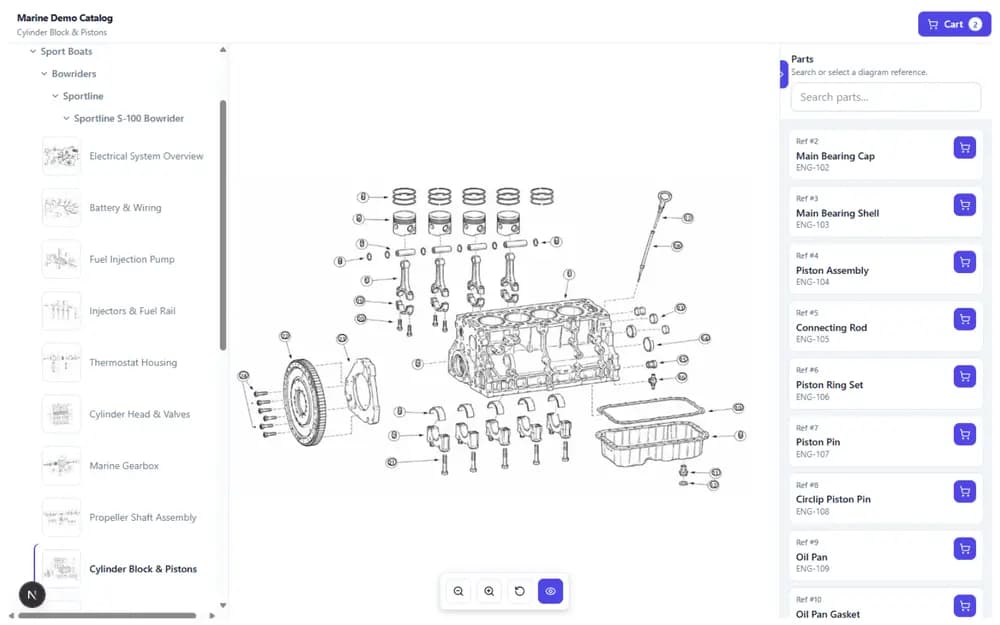
Dealer networks often depend on locally stored manuals, spreadsheets and exported price lists. Those copies quickly become inconsistent when a part number changes, a replacement is introduced or a new diagram is published.
PartGrid keeps the catalog structure and part relationships centrally governed while allowing each channel to receive the appropriate language, visibility and commercial context. Dealers can work from current interactive parts diagrams instead of maintaining their own disconnected document sets.
Network model
Maintain shared parts knowledge at headquarters, then provide suitable catalog experiences to dealers, markets and customer channels.
Infrastructure becomes powerful when it can distribute the right catalog experience to the right audience. PartGrid lets manufacturers manage one structured source while tailoring what each dealer sees.
Set regional visibility, local language and currency, and dealer-level access without duplicating catalogs for every market.
See dealer capabilitiesMaster data
245
Dealers
Controlled access
198
Dealers
Shared collections
Dealer pricing rules
Localized presentation
Embedded delivery
Localized
312
Dealers
Dealers use the same current diagrams and part relationships instead of local document copies.
CatalogConnect identified parts to suitable quote, cart or external ordering workflows.
CommerceAdapt language, currency and visible catalog context for the market being served.
LocalizationUse reusable collections, embeds and rules rather than building a separate catalog copy for every partner.
Dealers work from centrally maintained parts information.
Partners can identify parts and continue the workflow without routing every question to headquarters.
Regions and dealers receive suitable experiences without fragmenting the source catalog.
The underlying part record can remain shared while the dealer experience changes by market or account. Dealer pricing rules can provide the correct commercial context, and embedded viewers and collections can place the catalog inside an existing portal or website.
After a dealer identifies the correct part, the selection can continue into a quote, cart or external ordering process. This separates catalog governance from the commercial workflow while keeping both connected.
Map central parts data, dealer access and quote or ordering handoff in one focused session.