
Static documentation
Customers and service teams still depend on PDFs, spreadsheets and printed exploded views to identify parts.
About PartGrid
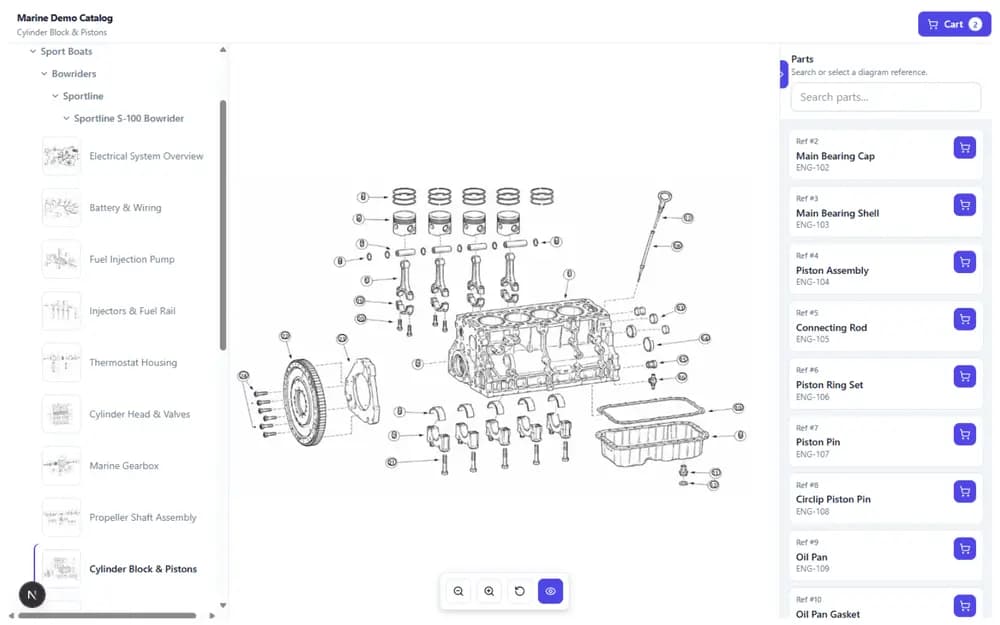
PartGrid helps parts businesses turn exploded views, parts lists, PDFs and catalog data into interactive experiences that make the right part easier to find, verify and order.
 Explore the live example
The problem
Technical documentation, parts lists, pricing, ecommerce data and service knowledge often live in separate files and systems. That makes parts identification slower for customers, dealers and internal teams.
Customers and service teams still depend on PDFs, spreadsheets and printed exploded views to identify parts.
Reference numbers, SKUs, descriptions, pricing and availability are often managed separately from the diagram customers use.
Different dealers, regions, languages and currencies make one consistent parts experience difficult to maintain.
What PartGrid does
PartGrid creates a structured layer between your existing documentation and the channels where people need to identify, quote or order parts.
Import exploded views, PDFs and parts lists and turn them into searchable, connected catalog data.
Detect numbered callouts and match them to part records, while keeping a manual review step available.
Embed interactive collections into websites, portals and ecommerce flows, or hand selected parts into cart and quote processes.
How we build
The platform is designed around the reality that parts data is imperfect, workflows differ and existing systems cannot simply be replaced.
AI-assisted matching can be reviewed and corrected before information reaches customers.
PartGrid is designed to complement ecommerce, PIM, ERP and service workflows rather than force a full rebuild.
Manage parts, schematics, categories and collections once and reuse them across channels and audiences.
Support multiple locales, currencies, collections and dealer-specific experiences from the same underlying platform.
Who it is for
PartGrid is most useful when products are complex, catalogs are large and visual identification matters.
Turn technical documentation into a scalable digital parts experience for customers, service teams and dealer networks.
Give different markets and dealers the right catalog, pricing and product visibility without duplicating the entire content base.
Make visual parts lookup part of the buying journey and connect identified parts directly to quote, cart or checkout workflows.
See how it works
Start with your existing diagrams and parts data. PartGrid connects them into an interactive experience that can be embedded into your current after-sales and ecommerce setup.
Use your existing diagrams and parts lists
Keep manual review where accuracy matters
Publish to customers, dealers and service teams