
Controlled catalog sharing
Share governed source collections with dealer companies instead of distributing disconnected catalog copies.
Dealer workspaces
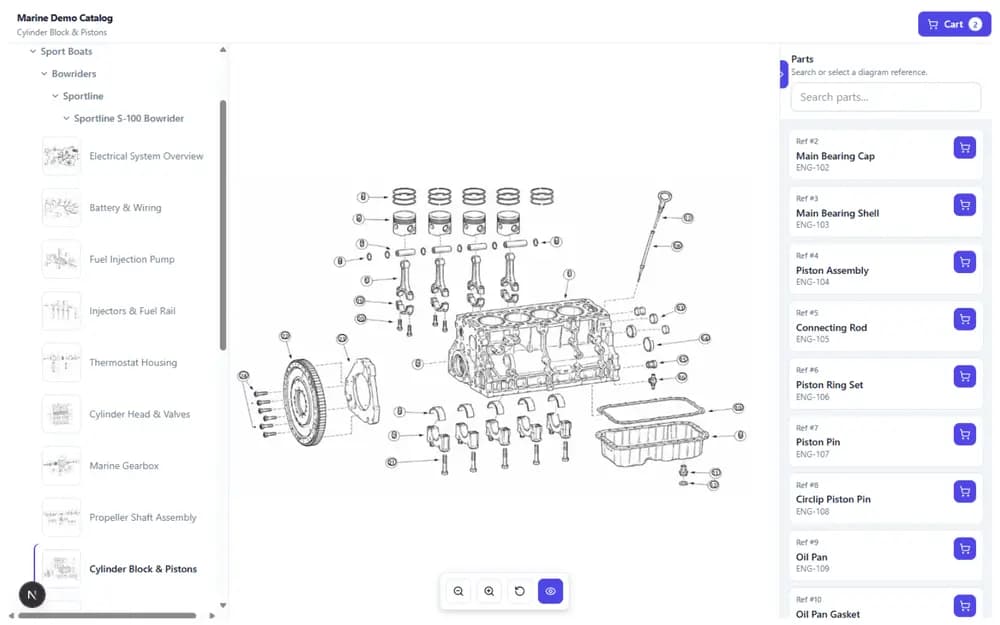
PartGrid lets OEMs and distributors share source collections with dealer companies while keeping the master catalog governed. Dealers can work with their assigned collection and use allowed visibility, pricing, localization, embed, and customer-facing workflows without creating a separate catalog copy.
Why dealer networks get fragmented
Dealer networks often end up with local files, spreadsheets, copied catalog pages, and repeated support requests. Every duplicate makes it harder to keep parts, diagrams, replacement guidance, pricing, and customer-facing experiences aligned with the source catalog.
Dealers need current parts data without editing the master catalog.
OEMs need a clear way to grant, pause, or revoke dealer access.
Dealer-specific pricing or visibility should not require another catalog copy.
Dealer-facing catalog updates should come from a governed source.
Dealers need a practical path from shared catalog access to customer-facing parts lookup.
The OEM or distributor keeps ownership of the source collection and the catalog data behind it.
Share the collection with a dealer company through the dealer access workflow.
The dealer accesses the assigned collection inside its own workspace while the source catalog remains governed by the catalog owner.
Where configured, dealer-specific visibility, pricing, localization, embed settings, and customer-facing workflows can be layered onto the shared collection.
Dealer access can be managed without handing over ownership of the source catalog.
Share governed source collections with dealer companies instead of distributing disconnected catalog copies.
Allow dealer-side visibility choices where configured without deleting parts from the source catalog.
Use dealer pricing rules and explicit overrides where configured while keeping source pricing separate.
Combine shared catalogs with supported locale and currency workflows for regional dealer experiences.
Use assigned dealer collections in customer-facing websites or portals where embed settings and domains allow it.
Connect identified parts to quote, cart, ecommerce, or downstream workflows where configured.
The source catalog stays governed by the OEM or distributor. Dealers operate a controlled layer for the workflows they are allowed to manage.
Dealer workspaces are designed for catalog distribution and dealer-facing parts workflows. They are not intended to replace a full dealer management system, CRM, ERP, order management platform, or complete B2B commerce stack.
For commercial price logic, see Dealer Pricing Rules. For broader dealer-network positioning, see Distributors & Dealer Networks. Operational guidance is available in Share collections with dealers and Manage an assigned dealer collection.
Frequently asked questions
Keep the source governed while giving dealers a practical operating layer.
A dealer workspace is the dealer-side environment where an assigned dealer company can work with shared catalog collections and the workflows enabled for that dealer relationship.
No. The source collection and underlying catalog remain governed by the OEM, distributor, or catalog owner.
Yes. Dealer access is designed to be managed as part of the dealer relationship, including pausing or revoking access where supported.
Dealer-specific pricing can be layered onto assigned dealer collections where configured. The detailed pricing capability is covered on the Dealer Pricing Rules page.
Yes, where embed and domain settings allow it, a dealer collection can be used in a customer-facing website or portal.
No. PartGrid dealer workspaces focus on dealer catalog sharing, access, presentation, pricing layers, embeds, and parts workflows rather than replacing CRM, ERP, DMS, or full commerce systems.
Give dealers controlled access to shared catalog experiences without rebuilding the catalog for every company or market.